
In this article
- What buying a tool actually gives you
- The gap between using AI and running on it
- So what is an AI workflow, exactly?
- The four parts of any AI workflow
- The uncomfortable part: it is your process, not the model
- The math your accountant will actually care about
- Keep the tools. Just stop calling it a strategy.
- How to start on Monday
Stop counting the tools you bought. Start counting the work that runs without you.
A distribution company I know bought fourteen AI licences in March. Adoption was not the problem. By June every seat was in daily use, and the team genuinely liked the tool.
The owner asked a fair question at the end of the quarter. Which line on this P&L moved?
Nobody could answer it. Quotes still took the same three days. The same person still re-keyed the same supplier data every Tuesday morning.
The tool was working exactly as sold. It had simply never been connected to anything. That is the difference between using AI and running on it, and almost nobody prices it.
What buying a tool actually gives you#
It is worth being fair to the tools, because they are not the problem and the cynicism about them is overdone.
A general-purpose assistant genuinely makes people faster. It drafts the email, summarises the long document, gets the first version of the proposal onto the page. Your staff are not imagining the benefit. In the MIT research below, these tools showed roughly 80% exploration inside organisations, which is a rate of uptake most software never sees.
But look closely at what that uptake produces. It produces individual productivity. One person finishes one task sooner.
That is real, and it is not nothing. It is also almost impossible to find in a set of accounts, because the time saved does not collect anywhere. It gets absorbed into the day. The report still goes out on Thursday. The quote still takes three days, because the two-hour saving sat inside a step that was never the bottleneck.
A tool speeds up a person. A workflow changes what the business does. Those are different purchases, and only one of them shows up in the numbers.
The gap between using AI and running on it#
Here is the strange shape of the current market. Adoption is high and impact is rare, at the same time.
On adoption, the U.S. Chamber of Commerce's Empowering Small Business report found around 60% of small businesses now using AI, with 58% using generative AI specifically. That is up from 40% the year before and more than double where it sat in 2023.
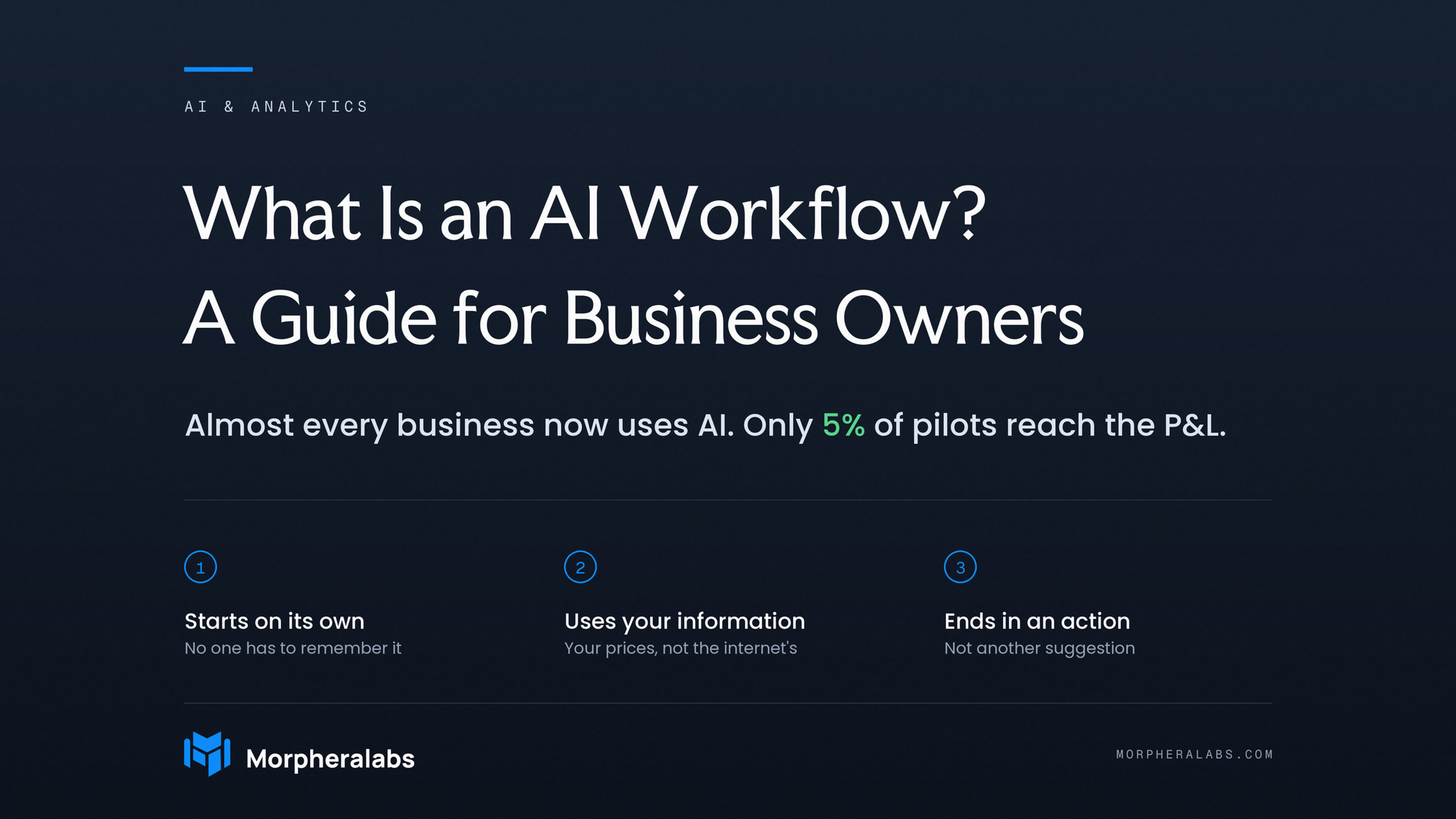
On impact, MIT's Project NANDA looked at more than 300 publicly disclosed AI initiatives, ran 52 structured interviews and surveyed 153 senior leaders between January and June 2025. Their finding: just 5% of integrated AI pilots were extracting millions in value, while the vast majority sat with no measurable P&L impact at all.
The attrition is steep and it is specific. Around 60% of enterprise-grade systems get evaluated. Roughly 20% reach a pilot. About 5% reach production.
So the question is not whether your people will use AI. They already do. The question is whether anybody owns the distance between a tool being used and a process being changed. In most companies that distance belongs to nobody, which is exactly why it does not get crossed.
So what is an AI workflow, exactly?#
There is a reasonable objection here, and it deserves a straight answer rather than a definition with more jargon in it.
The objection is that this sounds like automation with a new name. Businesses have been wiring systems together for thirty years. What is actually different?
One thing. Traditional automation can only handle steps you can write as a rule. If the invoice number is in box four, copy it to the spreadsheet. The moment a step requires reading something, weighing it, or deciding between two reasonable options, the rule breaks and a person has to take over. That person is usually the bottleneck.
An AI workflow is a defined sequence of steps that starts on its own, uses your own information, handles the judgement step in the middle, and finishes by doing something. Not suggesting something. Doing it.
Take the supplier email that arrives every Tuesday. The old version of automation could file it, because filing is a rule. It could not read the attachment, match seven product descriptions against your catalogue, notice that two prices moved, and update the ones that changed. A person did that, and the person was the reason it took until Thursday.
Put plainly: a tool waits for someone to open it. A workflow runs whether or not anyone remembers it exists.
That is the whole distinction, and it is worth more than any feature comparison you will read this year.
The four parts of any AI workflow#
Every workflow worth building has the same four parts. If you can name all four, you have a workflow. If you cannot, you have a tool with good intentions.
- A trigger. Something starts the work without a person deciding to start it. An email arrives. A form is submitted. It is Monday at 8am. This is the part people skip, and skipping it is why so much AI work quietly reverts to manual after a fortnight. If a human has to remember, it is not a workflow.
- Context. The workflow needs your information, not the internet's. Your price list, your past quotes, your customer history, your policies. A general assistant that does not know which of your three price lists is current will give you a confident, useless answer. This is the step most often missing, and it is the expensive one. Gartner expects organisations to abandon 60% of AI projects through 2026 where the data is not ready for them. In the survey behind that figure, of 248 data management leaders, 63% either did not have the right practices in place or were not sure whether they did.
- A judgement step. This is the part a rule cannot do. Read this supplier email and work out which of our SKUs it refers to. Decide whether this complaint needs a manager. Draft a reply in the tone we actually use. This is the only step where the model itself matters, and it is a much smaller part of the system than the marketing suggests.
- A checkpoint and an action. Someone approves it, or a confidence threshold does, and then the thing actually happens. The quote is sent. The record is updated. The ticket is routed. Without this fourth part you have built a very expensive suggestion box.
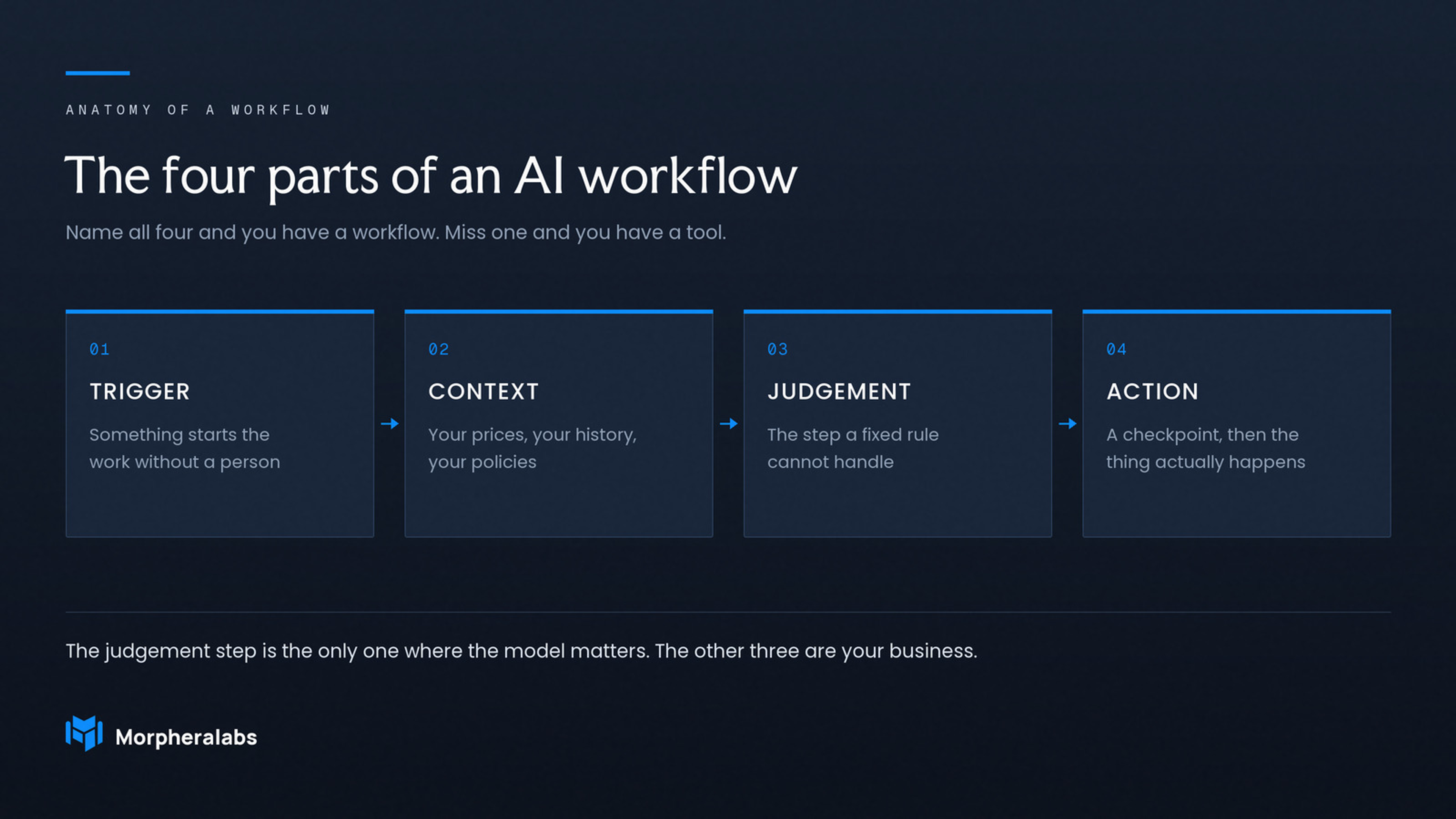
Write down any process in your business and try to fill in all four. The one you cannot complete is usually the one to build first.
The uncomfortable part: it is your process, not the model#
Most businesses that get disappointing results from AI go looking for a better model. That is almost always the wrong place to look.
The MIT researchers were direct about this. The barrier they identified was learning capability, not infrastructure and not talent. In their words, most systems "do not retain feedback, adapt to context, or improve over time." One interviewee described the everyday version of the problem: the tool is excellent for brainstorming and first drafts, but it does not retain knowledge of client preferences or learn from previous edits.
Read that again as a business problem rather than a technical one. It is not saying the model is not clever enough. It is saying nothing was built to remember.
The failures are usually boringly specific:
- Nobody wrote down how the task is actually done, so there is nothing to automate against.
- The data the workflow needs lives in one person's inbox.
- Corrections get made in the moment and disappear, so the same mistake arrives again next week.
- No one owns the process, so when it breaks on a Tuesday it quietly stops being used.
None of that is fixed by a better model. All of it is fixed by deciding how the work should run and then building that.
A disappointing AI result is usually a process problem wearing a technology costume.
The math your accountant will actually care about#
Skip the vendor case studies. Here is the arithmetic, with your own numbers dropped into it.
| Buying tools | Building a workflow | |
|---|---|---|
| What you pay | Per seat, every month | Once to build, then to maintain |
| What you get | One person finishes one task sooner | A step happens without anyone doing it |
| Where it shows up | Hard to find in the accounts | Cycle time, error rate, headcount you did not need |
| What happens when someone leaves | The saving leaves with them | The process keeps running |
| Effect over time | Flat | Compounds, because it can be improved |
The last row is the one that matters. Seat licences cost the same in year three as in year one and deliver roughly the same thing. A workflow you built gets better, because every correction can be folded back in.
This also explains the adoption paradox. Buying seats is easy, cheap and safe, so almost everyone does it. Building a workflow requires deciding how the work should actually run, which is harder, which is why 5% get there.
Keep the tools. Just stop calling it a strategy.#
None of this means cancelling the licences. Your team likes them, they save real time, and taking them away would be an unforced error.
What should change is what you expect from them. Seat licences are a productivity purchase, and you should judge them the way you judge any other one: are people using them, and do they want to keep them. They are not a transformation programme, and reporting them as one sets up a disappointment about eighteen months out.
There is a practical reason to keep both. The people using the tools every day are the ones who can tell you which processes are worth building, because they have spent six months working around the gaps by hand. That is free research, and most owners never ask for it.
Buy the tools for your people. Build the workflows for your business. They are different budgets answering different questions.
How to start on Monday#
You do not need a vendor, a platform decision, or a budget line to begin.
- Find the Tuesday task. Ask your team which job they do every week that feels like it should not need a person. You will hear the same three answers. That overlap is your shortlist, and it costs an afternoon to collect.
- Try to fill in the four parts. Take the first one and write down its trigger, its context, its judgement step, and its action. Where you get stuck is the actual problem. Usually it is context: the information exists, but only in somebody's head or somebody's inbox.
- Give it an owner and a number. Pick one process, give it to someone with the authority to change how it runs, and agree what you are measuring before you start. Cycle time is usually the honest one. A workflow with no owner becomes a tool nobody opens.
The point of all this is not to be early on AI. It is that almost every business is now measuring the wrong thing. How many people use it is a question about software. What runs without you is a question about the business.
One of those numbers is already high in your company. The other one is the one worth reporting.
Morpheralabs builds data platforms, cloud infrastructure and internal tooling for businesses that have reached the point where the tools stopped fitting. A lot of that work is the unglamorous middle: getting the information into a shape a workflow can actually use. If that sounds like where you are stuck, we are happy to talk it through.